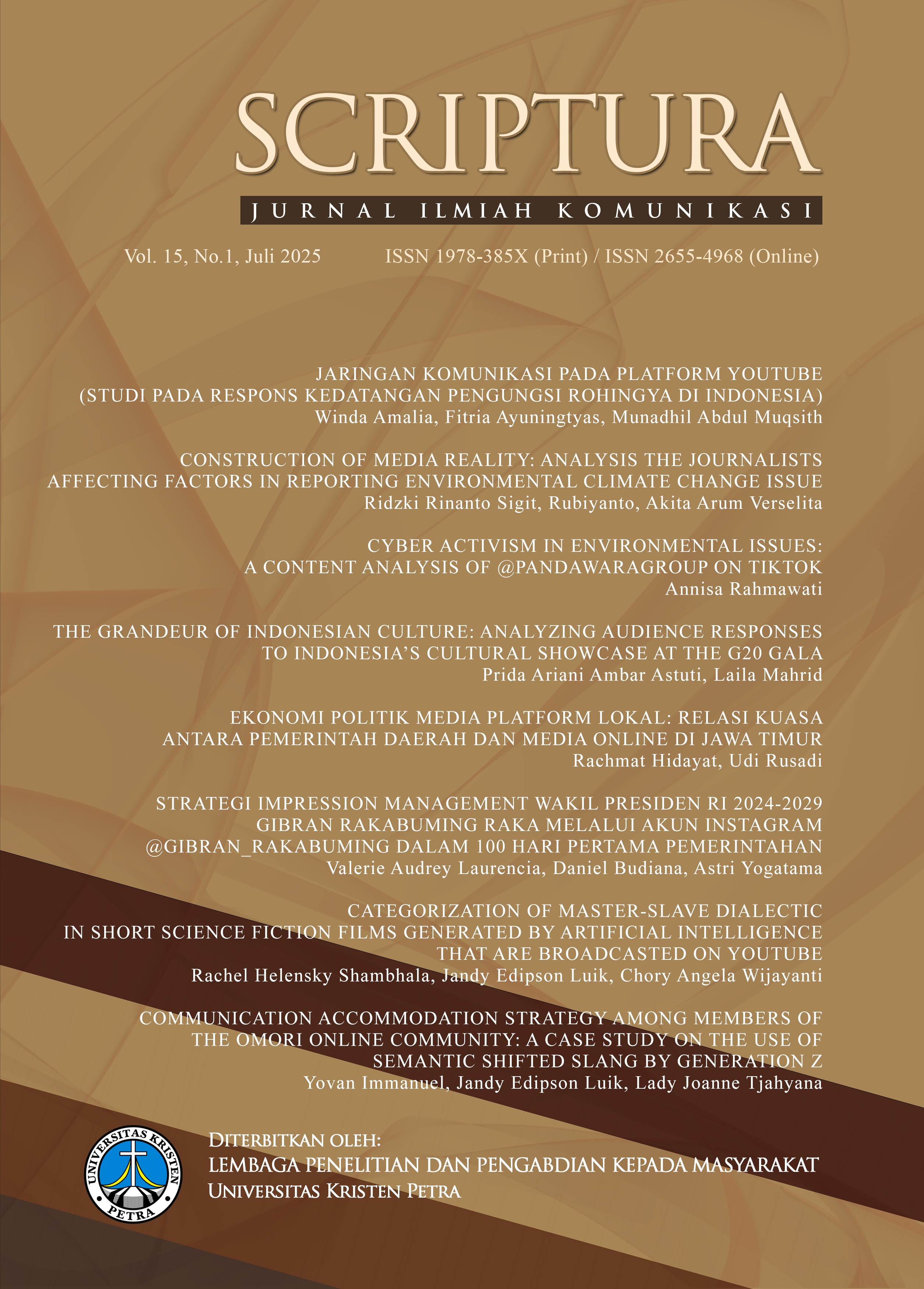
Construction of Media Reality: Analysis The Journalists Affecting Factors in Reporting Environmental Climate Change Issue
DOI:
https://doi.org/10.9744/scriptura.15.1.14-24Keywords:
media construction, environmental communication, environmental journalists, newsrooms, media coverageAbstract
Climate change is one of the most pressing global issues, yet its complexity often presents challenges for journalists in constructing accurate and compelling narratives. This study uses Berger and Luckmann's theory of the social construction of reality to understand how journalists shape climate change narratives in their journalistic practice. As an initial step, researchers distributed questionnaires to 30 environmental journalists, followed by in-depth interviews with five key informants. The study identified key determinants such as curiosity, professional experience, and critical reflection, as well as organizational factors including editorial support, access to training, and newsroom dynamics. The findings highlight the transformative role of journalists in shifting from traditional reporting to solutions-oriented journalism, which aims to inspire hope, motivate action, and support societal responses to climate change. The findings reveal that journalists with broader networks and stronger newsroom interactions tend to develop more in-depth narratives, contribute to solutions-based storytelling, and mobilize public awareness. An editorial environment that fosters autonomy and collaboration helps sustain journalistic engagement with environmental issues long-term. This study underscores the importance of micro-level interactions in shaping macro-level social narratives about climate change, highlighting journalists not only as conveyors of information but also as active agents of social transformation.
References
Adoni, H., & Mane, S. (1984). Media and the social construction of reality: Toward an integration of theory and research. Communication Research, 11(3), 323–340.
Agin, S., & Karlsson, M. (2021). Mapping the field of climate change communication 1993–2018: Geographically biased, theoretically narrow, and methodologically limited. Environmental Communication, 15(4), 431–446.
Almiron, N., & Xifra, J. (2020). Climate change denial and public relations: strategic communication and interest groups in climate inaction. Taylor & Francis.
Appelgren, E., & Jönsson, A. M. (2021). Engaging citizens for climate change—challenges for journalism. Digital Journalism, 9(6), 755–772.
Ballantyne, A. G. (2016). Climate change communication: what can we learn from communication theory? Wiley Interdisciplinary Reviews: Climate Change, 7(3), 329–344.
Banchero, P., Rector, T. A., & VanBallenberghe, J. (2021). Best practices in climate change communication as applied to an informal education documentary about Alaska. Journal of Geoscience Education, 69(2), 138–149.
Barkemeyer, R., Figge, F., Hoepner, A., Holt, D., Kraak, J. M., & Yu, P.-S. (2017). Media coverage of climate change: An international comparison. Environment and Planning C: Politics and Space, 35(6), 1029–1054.
Bayes, R., Bolsen, T., & Druckman, J. N. (2023). A research agenda for climate change communication and public opinion: The role of scientific consensus messaging and beyond. Environmental Communication, 17(1), 16–34.
Berger, P., & Luckmann, T. (2023). The Social Construction of Reality. In Social Theory Re-Wired (pp. 92–101). Routledge.
Canon, C. R., Boyle, D. P., & McAfee, S. A. (2022). Visualizing the structure and development of climate change communication research. Journal of Science Communication, 21(7), A03.
Chen, K., Molder, A. L., Duan, Z., Boulianne, S., Eckart, C., Mallari, P., & Yang, D. (2023). How climate movement actors and news media frame climate change and strike: evidence from analyzing twitter and news media discourse from 2018 to 2021. The International Journal of Press/Politics, 28(2), 384–413.
Chen, W.-Y., Suzuki, T., & Lackner, M. (2017). Handbook of climate change mitigation and adaptation. Springer International Publishing Cham, Switzerland.
Chen, Y., Thorson, K., & Lavaccare, J. (2022). Convergence and divergence: The evolution of climate change frames within and across public events. International Journal of Communication, 16, 23.
Eise, J., Lambert, N. J., Adekunle, T., Eversole, K., Eise, L., Murphy, M., & Sprouse, L. (2020). Climate change communication research: A systematic review. Available at SSRN 3683832.
Guenther, L., Jörges, S., Mahl, D., & Brüggemann, M. (2023). Framing as a Bridging Concept for Climate Change Communication: A Systematic Review Based on 25 Years of Literature. Communication Research, 00936502221137165.
Harris, D. M. (2020). Telling stories about climate change. The Professional Geographer, 72(3), 309–316.
Harrison, S., Macmillan, A., & Rudd, C. (2020). Framing climate change and health: New Zealand’s online news media. Health Promotion International, 35(6), 1320–1330.
Klein, N. (2015). This changes everything: Capitalism vs. the climate. Simon and Schuster.
Kunelius, R., & Roosvall, A. (2021). Media and the Climate Crisis. Nordic Journal of Media Studies, 3(1), 1–19. https://doi.org/doi:10.2478/njms-2021-0001
Lynas, M. (2008). Six degrees: Our future on a hotter planet. National Geographic Books.
Mah, A. Y. J., Chapman, D. A., Markowitz, E. M., & Lickel, B. (2020). Coping with climate change: Three insights for research, intervention, and communication to promote adaptive coping to climate change. Journal of Anxiety Disorders, 75, 102282.
Maibach, E. W., Uppalapati, S. S., Orr, M., & Thaker, J. (2023). Harnessing the Power of Communication and Behavior Science to Enhance Society’s Response to Climate Change. Annual Review of Earth and Planetary Sciences, 51, 53–77.
Maran, D. A., & Begotti, T. (2021). Media exposure to climate change, anxiety, and efficacy beliefs in a sample of Italian university students. International Journal of Environmental Research and Public Health, 18(17), 9358.
Medranda-Morales, N., Sánchez-Montoya, R., Ayuy Cevallos, J. V., & Soria Rojas, J. A. (2022). Challenges for the Construction of Environmental Journalism in Ecuador and the COP26 in Digital Media. Sustainability, 14(20), 13173.
Nabi, R. L., Gustafson, A., & Jensen, R. (2018). Framing climate change: Exploring the role of emotion in generating advocacy behavior. Science Communication, 40(4), 442–468.
Nurhaifa, S. (2023). Coil Reporter’s Understanding of Environmental Journalism. International Journal of Enviromental Communication (ENVICOMM), 1(1), 9–22.
Okoliko, D. A., & de Wit, M. P. (2021). From “communicating” to “engagement”: afro-relationality as a conceptual framework for climate change communication in Africa. Journal of Media Ethics, 36(1), 36–50.
Painter, J., Kangas, J., Kunelius, R., & Russell, A. (2022). The Journalism in Climate Change Websites: Their Distinct Forms of Specialism, Content, and Role Perceptions. Journalism Practice, 1–20.
Pong, V. (2021). Global versus local framing of the issue of food waste: The role of Identification With All Humanity and the implications for climate change communication. Asian Journal of Social Psychology, 24(2), 221–231.
Ruiz, I., Faria, S. H., & Neumann, M. B. (2020). Climate change perception: Driving forces and their interactions. Environmental Science & Policy, 108, 112–120.
Sakellari, M. (2022). Media coverage of climate change induced migration: Implications for meaningful media discourse. Global Media and Communication, 18(1), 67–89.
Schäfer, M. S., & Painter, J. (2020). Climate journalism in a changing media ecosystem: Assessing the production of climate change-related news around the world. WIREs Climate Change, 12 (1), e675. https://doi.org/10.1002/wcc.675
Schäfer, M. S., & Painter, J. (2021). Climate journalism in a changing media ecosystem: Assessing the production of climate change‐related news around the world. Wiley Interdisciplinary Reviews: Climate Change, 12(1), e675.
Schneider, C. R., Zaval, L., & Markowitz, E. M. (2021). Positive emotions and climate change. Current Opinion in Behavioral Sciences, 42, 114–120.
Seyranian, V., Lombardi, D., Sinatra, G. M., & Crano, W. D. (2022). Optimizing climate change communication: Context Comparison Model method. Frontiers in Psychology, 13, 897460.
Stammen, L., & Meissner, M. (2022). Social movements’ transformative climate change communication: extinction rebellion’s artivism. Social Movement Studies, 1–20.
Stecula, D. A., & Merkley, E. (2019). Framing climate change: Economics, ideology, and uncertainty in American news media content from 1988 to 2014. Frontiers in Communication, 4, 6.
Supran, G., & Oreskes, N. (2021). Rhetoric and frame analysis of ExxonMobil’s climate change communications. One Earth, 4(5), 696–719.
Tavakolifar, M., Omar, A., Lemma, T. T., & Samkin, G. (2021). Media attention and its impact on corporate commitment to climate change action. Journal of Cleaner Production, 313, 127833.
Theodora, L. C., & Prestianta, A. M. (2022). Measuring Constructive Journalism in Kompas. com’s Climate Change Articles. Jurnal ASPIKOM, 7(2), 95–110.
Treen, K. M. d’I, Williams, H. T. P., & O’Neill, S. J. (2020). Online misinformation about climate change. Wiley Interdisciplinary Reviews: Climate Change, 11(5), e665.
United Nations. (2023). UN Climate Change Conferences | United Nations. https://www.un.org/en/climatechange/un-climate-conferences
Wang, B. (2021). China’s Transition on Climate Change Communication and Governance. Springer.
Weitkamp, E., Milani, E., Ridgway, A., & Wilkinson, C. (2021). Exploring the digital media ecology: insights from a study of healthy diets and climate change communication on digital and social media. Journal of Science Communication, 20(3), A02.
Wetts, R., Morris, H. E., Boykoff, M., McNally, B., Painter, J., Sanford, M., Diamond, E. P., Esteve-del-Valle, M., Loy, L., & Perry, K. E. (2025). Climate media amidst technopolitical change: challenges, transformations, and new directions for research. Climatic Change, 178(6), 115.
William, J. (2022). Journal of Mass Communication & Journalism Editorial Environmental Communication: An Overview. https://doi.org/10.37421/2165-7912.22.12.458
Wu, M., Long, R., Yang, S., Wang, X., & Chen, H. (2022). Evolution of the Knowledge Mapping of Climate Change Communication Research: Basic Status, Research Hotspots, and Prospects. International Journal of Environmental Research and Public Health, 19(18), 11305.
Yang, X., Chen, L., & Ho, S. S. (2020). Does media exposure relate to the illusion of knowing in the public understanding of climate change? Public Understanding of Science, 29(1), 94–111.
Zhao, H. (2020). Explicating the social constructionist perspective on crisis communication and crisis management research: a review of communication and business journals. Journal of Public Relations Research, 32(3–4), 98–119.
Downloads
Published
Issue
Section
License
Copyright (c) 2025 Ridzki Rinanto Sigit, Rubiyanto, Akita Arum Verselita

This work is licensed under a Creative Commons Attribution 4.0 International License.
Authors who publish in the SCRIPTURA Jurnal Ilmiah agree to the following terms:
Authors retain unrestricted copyright and full publishing rights. The authors grant the Publisher the right of first publication, with the work simultaneously licensed under the terms and conditions of the Creative Commons Attribution License (CC BY) that allows for unlimited use, distribution, and content reproduction on all media as long as the original author and source are properly acknowledged and cited.