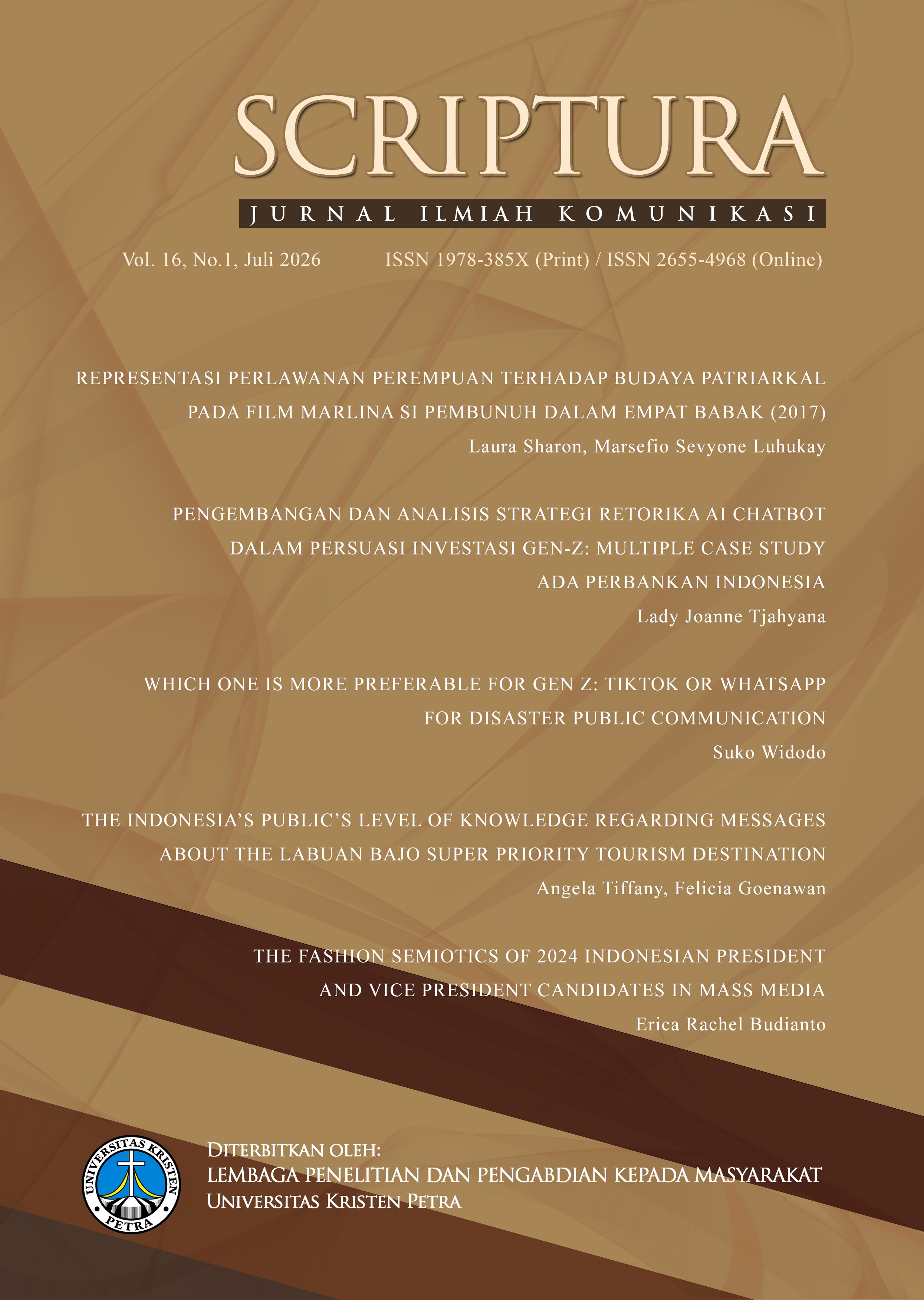
Which One is More Preferable for Gen Z: TikTok or WhatsApp for Disaster Public Communication
DOI:
https://doi.org/10.9744/scriptura.16.1.27-39Keywords:
disaster communication, generation z, TikTok, WhatsApp, Hybrid communicationAbstract
Indonesia is one of the world's most disaster-prone countries, making effective digital disaster communication essential, particularly for Generation Z, who rely heavily on social media as their primary source of information. This study aims to examine the preferences of Indonesian Generation Z in using TikTok and WhatsApp for disaster public communication and to identify the communication characteristics that make each platform effective. A qualitative approach was employed using six Focus Group Discussions involving 48 university students in Surabaya. Data were analyzed through thematic analysis to identify recurring patterns related to perceived urgency, message clarity, interactivity, and information shareability. The findings indicate that WhatsApp is perceived as the most effective platform for disseminating urgent disaster warnings due to its immediacy, trusted interpersonal networks, and rapid message delivery. In contrast, TikTok is preferred for providing explanatory, engaging, and memorable disaster information through visual storytelling and interactive features. Rather than favoring a single platform, participants consistently advocated a hybrid communication strategy that combines WhatsApp for initial emergency alerts and TikTok for subsequent educational and persuasive communication. This study contributes to disaster communication research by proposing a hybrid platform model that aligns with Generation Z's digital communication practices and offers practical implications for disaster management agencies in designing more effective digital public communication strategies.
References
Adams, C., & Neef, A. (2019). Patrons of disaster: The role of political patronage in flood response in the Solomon Islands. World Development Perspectives, 15(July). https://doi.org/10.1016/j.wdp.2019.100128
Agyepong, L. A., & Liang, X. (2023). Mapping the knowledge frontiers of public risk communication in disaster risk management. Journal of Risk Research, 26(3), 302–323. https://doi.org/10.1080/13669877.2022.2127851
Aryal, A., Kim, K. Y., & Lakshmi, V. (2025). Understanding flood dynamics in the Indus River Basin: Lessons from the 2022 Pakistan deluge. Journal of Hydrology: Regional Studies, 59, 102362.
Astuti, C. W., & Kristiyono, J. (2025). Digital Storytelling di Konten Kecantikan TikTok: Membangun Kepercayaan Konsumen dan Perilaku Pembelian di Kalangan Gen Z di Surabaya. JINTACT: Journal of Interactive Communicaton, Public Relations and Broadcasting, 1(1), 33-44.
Athukorala, P., & Resosudarmo, B. P. (2005). The Indian Ocean Tsunami: Economic Impact, Disaster Management, and Lessons. Asian Economic Papers. https://doi.org/10.1162/asep.2005.4.1.1
Blandi, L., Sabbatucci, M., Dallagiacoma, G., Alberti, F., Bertuccio, P., & Odone, A. (2022). Digital Information Approach through Social Media among Gen Z and Millennials: The Global Scenario during the COVID-19 Pandemic. Vaccines, 10(11), 1822. https://doi.org/10.3390/vaccines10111822
de Freitas Melo, P., Kansaon, D., Couto, J. M. M., Reis, J. C. S., & Benevenuto, F. (2025). A Sticker is Worth a Thousand Words: Characterizing the Use and Abuse of Stickers on WhatsApp Political Groups in Brazil. Proceedings of the International AAAI Conference on Web and Social Media, 19, 1210–1223.
De Leon, M. V, Susilo, D., Putranto, T. D., Hartati, F. K., & Santos, R. R. T. (2021). Managing the uncertainty during COVID-19 pandemic: Communicating disaster and food industry sustainability. In Y. A.C., S. D.F., M. M.T., & R. R. (Eds.), 2nd International Conference Earth Science and Energy, ICESE 2020 (Vol. 819, Number 1). IOP Publishing Ltd. https://doi.org/10.1088/1755-1315/819/1/012039
Djalante, R., Lassa, J., Setiamarga, D., Mahfud, C., Sudjatma, A., Indrawan, M., Haryanto, B., Sinapoy, M., Rafliana, I., Djalante, S., Gunawan, L., Anindito, R., Warsilah, H., & Surtiari, I. (2020). Review And Analysis of Current Responses to COVID-19 in Indonesia: Period of January to March 2020. Progress in Disaster Science, 6. https://doi.org/https://doi.org/10.1016/j.pdisas.2020.100091
Dunas, D. V., & Vartanov, S. A. (2020). Emerging digital media culture in Russia: modeling the media consumption of Generation Z. Journal of Multicultural Discourses, 15(2), 186–203. https://doi.org/10.1080/17447143.2020.1751648
Fatria, A. E., & Christantyawati, N. (2018). Pergeseran Merek Smartphone diIndonesia dalam PerspektifPostmodernisme. Jurnal Studi Komunikasi, 2(2), 256–277. https://doi.org/10.25139/jsk.v2i2.379
Firmansyah, B. A., & Disyacitta, F. (2024). Pengaruh Jingle Pemilu serentak 2024 di Instagram Terhadap kesadaran memilih gen-z di Kabupaten Bantul. Lektur: Jurnal Ilmu Komunikasi, 7(1).
Gentina, E. (2019). Generation Z in France: Reverse Socialisation and Social Engagement. Generations Z in Europe (The Changing Context of Managing People), Emerald Publishing Limited, 109–126.
Geurts, B., Weishaar, H., Mari Saez, A., Cristea, F., Rocha, C., Aminu, K., Tan, M. M. J., Salim Camara, B., Barry, L., & Thea, P. (2023). Communicating risk during early phases of COVID-19: Comparing governing structures for emergency risk communication across four contexts. Frontiers in Public Health, 11, 1038989.
Gil de Zúñiga, H., Ardèvol-Abreu, A., & Casero-Ripollés, A. (2021). WhatsApp political discussion, conventional participation and activism: exploring direct, indirect and generational effects. Information, Communication & Society, 24(2), 201–218. https://doi.org/10.1080/1369118X.2019.1642933
Greenberg, M. (2022). Strategies to be prepared for a risk communication crisis. Risk Analysis, 42(11), 2354–2361.
Heinkel, S.-B., Miller, C., Thiebes, B., Than, Z. M., Kyi, T. T., Aung, T., Oo, S. S., Mar, W. L., Willkomm, M., & Maung, W. (2025). Institutional risk and crisis communication on natural hazards and disaster risks in Yangon, Myanmar. International Journal of Disaster Risk Reduction, 116, 105064.
Intan Salina Che Sulaiman, Nawi, N. H. M., Hasdhatul Norasyikin Mf Said, Singhapakdi, A., Vitell, S. J., Franke, G. R., (Nurarif & Kusuma, 2016), Bush, T., Ng, A. Y. M., Wei, K. T., Chay, J., Glover, D., Lei, M. T., Kementerian Pendidikan Malaysia, Jones, T. M., Lincoln, S. H., Holmes, E. K., Amirul, M., Bin, H. A. Q., … Guru, I. P. (2014). Konsep Penerapan Dan Penghayatan Nilai-Nilai Murni Berasaskan Falsafah Pendidikan Kebangsaan ( FPK ). Journal of Chemical Information and Modeling. https://doi.org/10.1017/CBO9781107415324.004
Jokhanan Kristiyono, S. T., & Kom, M. M. (2022). Konvergensi media: Transformasi media komunikasi di era digital pada masyarakat berjejaring. Prenada Media.
Jokhanan Kristiyono, S. T., & Kom, M. M. (2020). KOMUNIKASI GRAFIS: Dilengkapi Panduan Teknis Desain Layout dengan Aplikasi Software Grafis InDesign. Prenada Media.
Kanbach, D. K., Heiduk, L., Blueher, G., Schreiter, M., & Lahmann, A. (2023). The GenAI is out of the bottle: generative artificial intelligence from a business model innovation perspective. Review of Managerial Science. https://doi.org/10.1007/s11846-023-00696-z
Kristiyono, J. (2015). Budaya internet: Perkembangan teknologi informasi dan komunikasi dalam mendukung penggunaan media di masyarakat. Scriptura, 5(1), 23-30.
Kristiyono, J., & Nurrosyidah, A. (2021). Analisis perilaku pencarian informasi di internet melalui fitur visual search. Scriptura, 11(2), 96-104.
Kristiyono, J., Febriyanti, S. N., & Ida, R. (2024). The visual identity of Indonesian post-structuralism in@ visual. jalanan's Instagram street art. Jurnal Studi Komunikasi, 8(3), 697-714.
Kristiyono, J., Islami, M. J., Sari, R. P., & Suprihatin, S. (2022). Visual Data Mining: Digital Visual Activities In Network Society. ETTISAL: Journal of Communication, 7(2), 161-173.
Lemy, D., Rahardja, A., & Kilya, C. (2021). Generation Z Awareness on Food Waste Issues (a Study in Tangerang, Indonesia). Journal of Business on Hospitality and Tourism, 6(2), 329–337.
Mysiak, J., Surminski, S., Thieken, A., Mechler, R., & Aerts, J. (2015). Brief Communication: Sendai Framework for Disaster Risk Reduction – success or warning sign for Paris? Natural Hazards and Earth System Sciences Discussions, 3(6), 3955–3966. https://doi.org/10.5194/nhessd-3-3955-2015
Putranto, T. (2018). Kelas Sosial Dan Perempuan Generasi Z di Surabaya Dalam Membuat Keputusan Setelah Lulus Sekolah Menengah Atas. Jurnal Komunikasi Profesional. https://doi.org/10.25139/jkp.v2i1.841
Rahma, A. (2018). Implementasi Program Pengurangan Risiko Bencana(PRB) Melalui Pendidikan Formal. Jurnal VARIDIKA, 30(1), 1–11. https://doi.org/10.23917/varidika.v30i1.6537
Rue, P. (2018). Make Way, Millennials, Here Comes Gen Z. About Campus: Enriching the Student Learning Experience, 23(3), 5–12. https://doi.org/10.1177/1086482218804251
Saito, H., & Matsuyama, H. (2012). Catastrophic landslide disasters triggered by record-breaking rainfall in Japan: Their accurate detection with Normalized Soil Water Index in the Kii Peninsula for the year 2011. Sola, 8, 81–84.
Schwarz, A., Sellnow, D. D., Diers-Lawson, A., & Sellnow, T. D. (2025). The crisis response to the Türkiye Syria earthquakes in 2023: Instructional emergency risk communication by the government, the national disaster management agency, and NGOs via press releases and microblogs. International Journal of Disaster Risk Reduction, 105770.
Shaw, R. (2014). Community Practices for Disaster Risk Reduction in Japan. Disaster Risk Reduction. https://doi.org/10.1007/978-4-431-54246-9
Srinivas, H., & Nakagawa, Y. (2008). Environmental implications for disaster preparedness: Lessons Learnt from the Indian Ocean Tsunami. Journal of Environmental Management. https://doi.org/10.1016/j.jenvman.2007.01.054
Susilo, D., Indrasari, M., Harliantara, Iristian, J., & Yunus, E. (2020). Managing uncertainty during disaster: Case on typhoon hagibis japan. IOP Conference Series: Earth and Environmental Science. https://doi.org/10.1088/1755-1315/519/1/012015
Susilo, D., & Putranto, T. D. (2018). Indonesian Youth on Social Media: Study on Content Analysis. https://doi.org/10.2991/sshr-17.2018.15
Twigg, J. (2007). Karakteristik Masyarakat Tahan Bencana. DFID Disaster Risk Reduction Interagency Coordination Group Whaley‟ s.
Wahyuni, H. I., & Haryadi, F. T. (2020). Haze Disaster Discourses in Local Indonesian Media: Examining Niklas Luhmann’s Perspective on Ecological Communication. Asia-Pacific Social Science Review, 20(1).
Widodo, S. (2025). Is the broadcast WhatsApp group still effective for delivering emergency messages to Gen Z? Jurnal Komunikasi Profesional, 9(1), 24–34.
Widodo, S., Kristiyono, J., Aji, G. G., & Zulaikha, Z. (2026). Digital Capitalism and Platform Dependency in Indonesia: Media, Power, and Political Economy. The Journal of Society and Media, 10(1), 36-57.
Yordudom, T., Nui-Suk, C., Imjai, N., Sumiati, S., & Aujirapongpan, S. (2026). Developing open innovation competency in Gen Z entrepreneurship students: Roles of absorptive capacity, AI literacy and algorithmic thinking skills. The International Journal of Management Education, 24(1), 101326.
Downloads
Published
Issue
Section
License
Copyright (c) 2026 Suko Widodo

This work is licensed under a Creative Commons Attribution 4.0 International License.
Authors who publish in the SCRIPTURA Jurnal Ilmiah agree to the following terms:
Authors retain unrestricted copyright and full publishing rights. The authors grant the Publisher the right of first publication, with the work simultaneously licensed under the terms and conditions of the Creative Commons Attribution License (CC BY) that allows for unlimited use, distribution, and content reproduction on all media as long as the original author and source are properly acknowledged and cited.