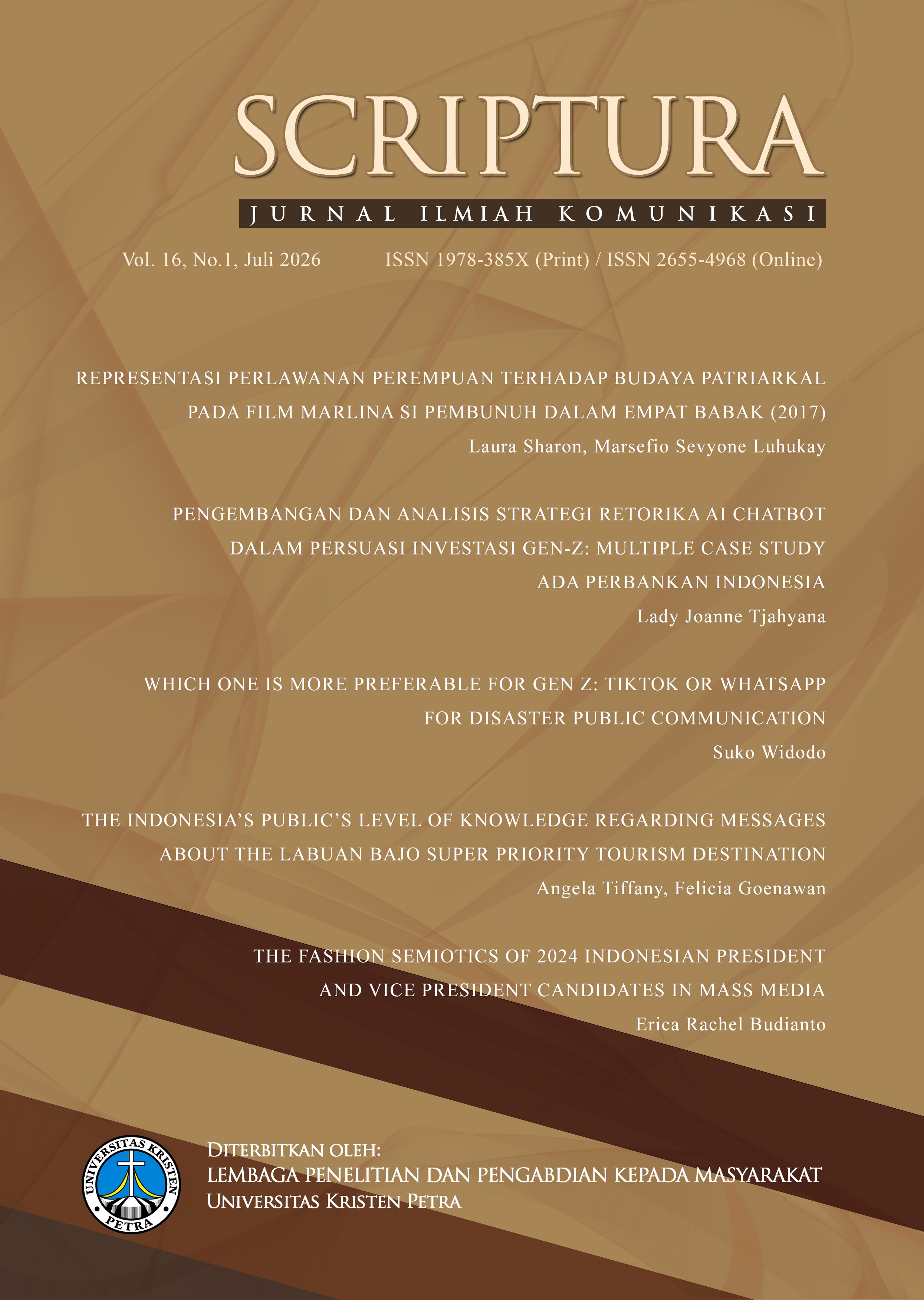
Pengembangan dan Analisis Strategi Retorika AI Chatbot dalam Persuasi Investasi Gen-Z: Multiple Case Study pada Perbankan Indonesia
DOI:
https://doi.org/10.9744/scriptura.16.1.13-26Keywords:
Chatbot AI, strategi retorika, komunikasi persuasif, gen-z, investasiAbstract
Integrasi teknologi AI chatbot dalam sistem perbankan sedang menghadapi tantangan yaitu bagaimana mempersuasi Generasi Z (Gen-Z) untuk berinvestasi di tengah ketidakpastian akibat krisis geopolitik dan krisis keamanan transaksi digital. Penelitian ini bertujuan menganalisis penggunaan strategi retorika klasik yaitu ethos, pathos, dan logos dalam pengembangan AI chatbot untuk mempersuasi Gen-Z agar tetap berinvestasi secara bijak. Melalui metode multiple study case, sebanyak dua puluh AI chatbot dikembangkan mewakili empat bank nasional yang mencakup bank tradisional dan bank digital. Data diperoleh dari empat ratus sesi percakapan yang dianalisis menggunakan teknik pattern matching, logika replikasi, dan sintesis lintas kasus. Hasil penelitian menunjukkan strategi logos mendominasi tema edukasi untuk menjelaskan konsep investasi yang rumit. Sementara itu, strategi ethos dilakukan untuk membangun kredibilitas melalui referensi otoritas resmi dan lebih menonjol digunakan pada AI chatbot bank tradisional. Sedangkan strategi pathos digunakan untuk menenangkan Gen-Z saat krisis, serta untuk melakukan pendekatan emosional. Strategi logos dan pathos lebih dominan ditemukan pada AI chatbot bank digital. Gaya friendly terbukti meningkatkan engagement, namun gaya formal tetap dibutuhkan untuk membangun kepercayaan terhadap rekomendasi investasi. Penelitian ini menyimpulkan bahwa adaptive mixed style merupakan strategi paling efektif untuk mempersuasi dan mengedukasi Gen-Z di tengah krisis yang terjadi saat ini.
References
Alkaraan, F., Albahloul, M., & Hussainey, K. (2023). Carillion’s strategic choices and the boardroom’s strategies of persuasive appeals: Ethos, logos and pathos. Journal of Applied Accounting Research, 24(4), 726–744. https://doi.org/10.1108/JAAR-06-2022-0134
Arbar, T. (2026, June 1). Korban Masih Berjatuhan, Kenali Tanda-Tanda Phishing Bagi Nasabah Bank. CNBC Indonesia. https://www.cnbcindonesia.com/market/20260601123136-17-739139/korban-masih-berjatuhan-kenali-tanda-tanda-phishing-bagi-nasabah-bank
Aristotle. (2010). Rhetoric. Cosimo, Inc.
Boubker, O. (2024). From chatting to self-educating: Can AI tools boost student learning outcomes? Expert Systems with Applications, 238, 121820. https://doi.org/10.1016/j.eswa.2023.121820
Bustomi, M. I. (2025, September 29). Ramai BCA Mobile dan MyBCA Error, Transaksi Gagal hingga Uang Terpotong. https://megapolitan.kompas.com/read/2025/09/29/13351121/ramai-bca-mobile-dan-mybca-error-transaksi-gagal-hingga-uang-terpotong
Cannas, V. G., Ciano, M. P., Saltalamacchia, M., & Secchi, R. (2024). Artificial intelligence in supply chain and operations management: A multiple case study research. International Journal of Production Research, 62(9), 3333–3360. https://doi.org/10.1080/00207543.2023.2232050
Chen, Q., Yin, C., & Gong, Y. (2023). Would an AI chatbot persuade you: An empirical answer from the elaboration likelihood model. Information Technology & People. https://doi.org/10.1108/ITP-10-2021-0764
Chen, Q., Yin, C., & Gong, Y. (2025). Would an AI chatbot persuade you: An empirical answer from the elaboration likelihood model. Information Technology & People, 38(2), 937–962. https://doi.org/10.1108/ITP-10-2021-0764
Coleman, M. (2021). Leveraging the Rhetorical Energies of Machines: COVID-19, Misinformation, and Persuasive Labor. Human-Machine Communication, 3, 11–26. https://doi.org/10.30658/hmc.3.2
Danielsson, J., & Uthemann, A. (2025). Artificial intelligence and financial crises. Journal of Financial Stability, 80, 101453. https://doi.org/10.1016/j.jfs.2025.101453
Dehnert, M., & Mongeau, P. A. (2022). Persuasion in the Age of Artificial Intelligence (AI): Theories and Complications of AI-Based Persuasion. Human Communication Research, 48(3), 386–403. https://doi.org/10.1093/hcr/hqac006
Gupta, V., Singh, S., & Yadav, S. S. (2022). The impact of media sentiments on IPO underpricing. Journal of Asia Business Studies, 16(5), 786–801. https://doi.org/10.1108/JABS-10-2020-0404
Guzman, A. L. (Ed.). (2018). Human-Machine Communication. Peter Lang US. https://doi.org/10.3726/b14399
Ho, R. C., Amin, M., Basir Malan, I. N., & Wong, C. H. (2026). The use of conversational AI chatbot by Gen Z in managing financial behavior: Interplay between financial knowledge and customer engagement. International Journal of Quality and Service Sciences, 1–24. https://doi.org/10.1108/IJQSS-11-2025-0332
Hwang, S., & Kim, J. (2021). Toward a Chatbot for Financial Sustainability. Sustainability, 13(6), 3173. https://doi.org/10.3390/su13063173
Jiang, H., Cheng, Y., Yang, J., & Gao, S. (2022). AI-powered chatbot communication with customers: Dialogic interactions, satisfaction, engagement, and customer behavior. Computers in Human Behavior, 134, 107329. https://doi.org/10.1016/j.chb.2022.107329
Kediya, D. S. O., Dhote, D. S., Kumar, D. D., Bidve, D. V. S., Pathan, S., Uparkar, S. S., Golar, P. C., & Anup, D. (2023). Are AI and Chat Bots Services Effects the Psychology of Users in Banking Services and Financial Sector.
Khan, A. W., & Mishra, A. (2024). AI credibility and consumer-AI experiences: A conceptual framework. Journal of Service Theory and Practice, 34(1), 66–97. https://doi.org/10.1108/JSTP-03-2023-0108
Konat, B., Gajewska, E., & Rossa, W. (2024). Pathos in Natural Language Argumentation: Emotional Appeals and Reactions. Argumentation, 38(3), 369–403. https://doi.org/10.1007/s10503-024-09631-2
Kumar, S., Kumar, P., Priya, P., & Patel, G. (2025). Mapping the evolution of artificial intelligence (AI) chatbot in marketing: A bibliometric analysis. Journal of Asia Business Studies, 19(6), 1253–1275. https://doi.org/10.1108/JABS-12-2024-0664
Kurniawan, G. (2026, April 19). Kronologi Krisis Selat Hormuz: Dari Serangan hingga Guncangan Pasar. CNBC Indonesia. https://www.cnbcindonesia.com/research/20260418214243-128-727871/kronologi-krisis-selat-hormuz-dari-serangan-hingga-guncangan-pasar
Liew, T. W., Tan, S.-M., Yoo, N. E., Gan, C. L., & Lee, Y. Y. (2023). Let’s talk about Sex!: AI and relational factors in the adoption of a chatbot conveying sexual and reproductive health information. Computers in Human Behavior Reports, 11, 100323. https://doi.org/10.1016/j.chbr.2023.100323
Malik, A. R., Pratiwi, Y., Andajani, K., Numertayasa, I. W., Suharti, S., Darwis, A., & Marzuki. (2023). Exploring Artificial Intelligence in Academic Essay: Higher Education Student’s Perspective. International Journal of Educational Research Open, 5, 100296. https://doi.org/10.1016/j.ijedro.2023.100296
Mays, K. K., & Novozhilova, E. (2026). AI Humanizers, Pragmatists, Skeptics: A Cluster Analysis of Normative Attitudes for AI’s Capabilities and Roles. Human-Machine Communication, 12(1), 113–138. https://doi.org/10.30658/hmc.12.6
Mulchandani, P., Pandey, R., Debata, B., & Renganathan, J. (2025). Investor attention and IPO returns: Evidence from Indian markets. Journal of Economic and Administrative Sciences, 41(3), 1002–1019. https://doi.org/10.1108/JEAS-03-2022-0075
Ozili, P. K. (2026). Artificial Intelligence (AI), Financial Stability and Financial Crisis. In International Encyclopedia of Business Management (pp. 591–595). Elsevier. https://doi.org/10.1016/B978-0-443-13701-3.00487-4
Prahl, A., & Edwards, A. (2023). Defining Dialogues: Tracing the Evolution of Human-Machine Communication. Human-Machine Communication, 6, 7–16. https://doi.org/10.30658/hmc.6.1
Pramudatama, S. B. (2024, December 1). Milenial dan Gen Z Lebih Sering Konsultasi Keuangan ke AI. liputan6.com. https://www.liputan6.com/bisnis/read/5808293/milenial-dan-gen-z-lebih-sering-konsultasi-keuangan-ke-ai
Rahayu, I. R. S., & Djumena, E. (2026, January 27). BCA Bukukan Laba Bersih Rp 57,5 Triliun Sepanjang 2025. KOMPAS.com. https://money.kompas.com/read/2026/01/27/203757026/bca-bukukan-laba-bersih-rp-575-triliun-sepanjang-2025
Sætra, H. S. (2024). A Machine’s ethos? An inquiry into artificial ethos and trust. Computers in Human Behavior, 153, 108108. https://doi.org/10.1016/j.chb.2023.108108
Sands, S., Ferraro, C., Campbell, C., & Tsao, H.-Y. (2021). Managing the human–chatbot divide: How service scripts influence service experience. Journal of Service Management, 32(2), 246–264. https://doi.org/10.1108/JOSM-06-2019-0203
Sanjaya, Y. C. A. (2025, August 13). Peringkat Perusahaan Terbesar di Indonesia 2025: Didominasi BUMN, Nomor 1 BRI. KOMPAS.com. https://www.kompas.com/tren/read/2025/08/13/100000865/peringkat-perusahaan-terbesar-di-indonesia-2025--didominasi-bumn-nomor-1
Subiyantoro, S., Degeng, I. N. S., Kuswandi, D., & Ulfa, S. (2023). Exploring the Impact of AI-Powered Chatbots (Chat GPT) on Education: A Qualitative Study on Benefits and Drawbacks. Jurnal Pekommas, 8(2), 157–168. https://doi.org/10.56873/jpkm.v8i2.5206
Tesaloni, L. (2025, December 31). Tren Saham Perbankan 2025: Bank Digital Bersinar, Bank Besar Tertinggal. PT. Kontan Grahanusa Mediatama. https://pusatdata.kontan.co.id/news/tren-saham-perbankan-2025-bank-digital-bersinar-bank-besar-tertinggal
Tesaloni, L. (2026, April 24). Moncer, Bank Jago (ARTO) Cetak Laba Rp 86 Miliar di Kuartal I-2026. PT. Kontan Grahanusa Mediatama. https://keuangan.kontan.co.id/news/moncer-bank-jago-arto-cetak-laba-rp-86-miliar-di-kuartal-i-2026
Tjahyana, L. J. (2024). Exploring AI Chatbot Development for Gen-Z: A Study on First-Time and Experienced Voters in Pemilu. Jurnal Ilmu Komunikasi Dan Bisnis, 9(2), 224–236. https://doi.org/https://doi.org/10.36914/1q9cb862
Tjahyana, L. J. (2025). Komunikasi Persuasif Berbasis AI: Strategi Retorika Chatbot dalam Adopsi Bitcoin oleh Mahasiswa. Jurnal Komunikatif, 14(1), 46–61. https://doi.org/10.33508/jk.v14i1.7332
Yin, R. K. (2017). Case Study Research and Applications: Design and Methods. SAGE Publications.
Yu, S., & Zhao, L. (2024). Emojifying chatbot interactions: An exploration of emoji utilization in human-chatbot communications. Telematics and Informatics, 86, 102071. https://doi.org/10.1016/j.tele.2023.102071
Zhang, X., Chen, A. L., Piao, X., Yu, M., Zhang, Y., & Zhang, L. (2024). Is AI chatbot recommendation convincing customer? An analytical response based on the elaboration likelihood model. Acta Psychologica, 250, 104501. https://doi.org/10.1016/j.actpsy.2024.104501
Zhao, X., Sun, Y., Liu, W., & Wong, C.-W. (2025). Tailoring generative AI chatbots for multiethnic communities in disaster preparedness communication: Extending the CASA paradigm. Journal of Computer-Mediated Communication, 30(1), zmae022. https://doi.org/10.1093/jcmc/zmae022
Downloads
Published
Issue
Section
License
Copyright (c) 2026 Lady Joanne Tjahyana

This work is licensed under a Creative Commons Attribution 4.0 International License.
Authors who publish in the SCRIPTURA Jurnal Ilmiah agree to the following terms:
Authors retain unrestricted copyright and full publishing rights. The authors grant the Publisher the right of first publication, with the work simultaneously licensed under the terms and conditions of the Creative Commons Attribution License (CC BY) that allows for unlimited use, distribution, and content reproduction on all media as long as the original author and source are properly acknowledged and cited.