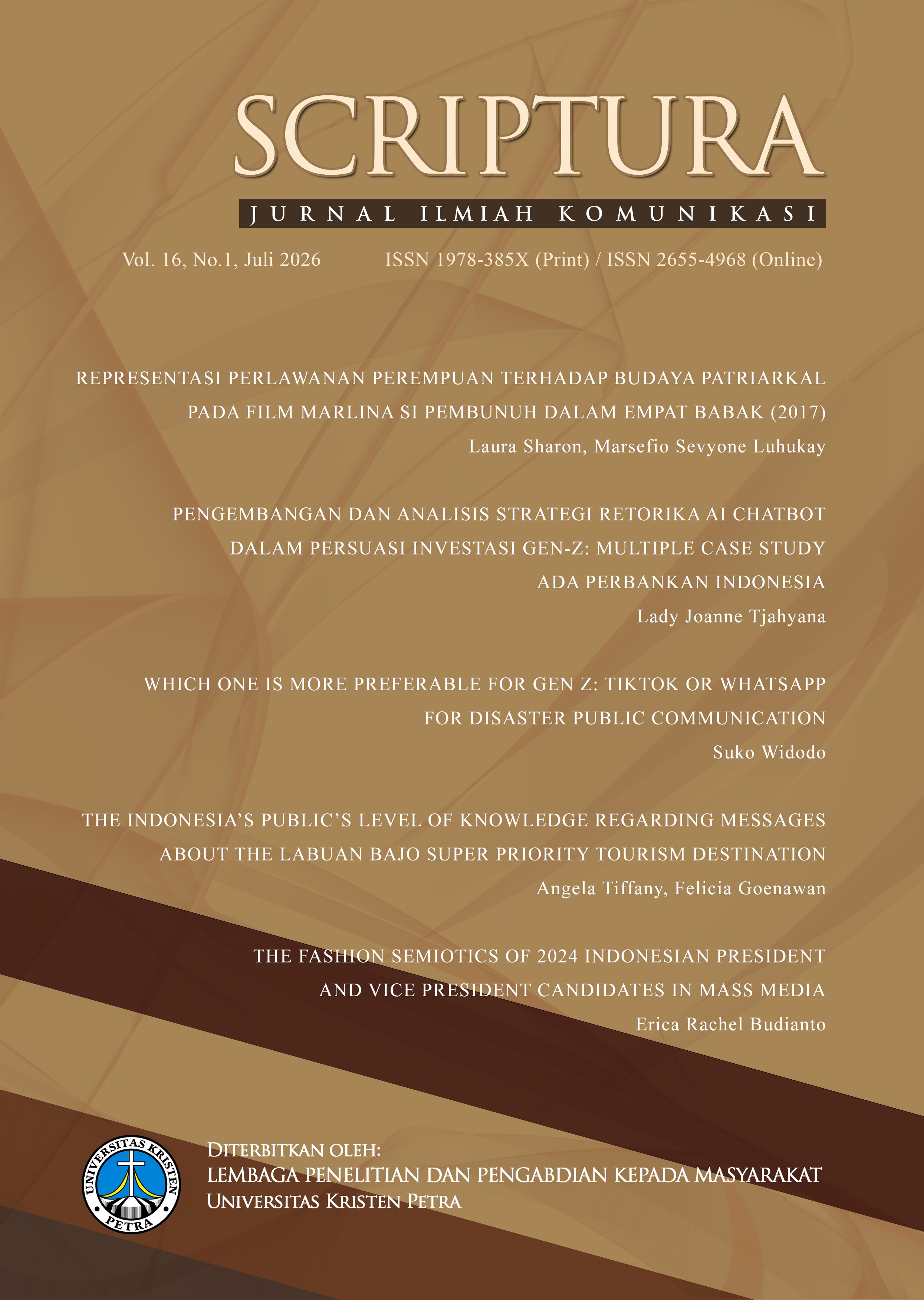
The Indonesia’s Public’s Level of Knowledge Regarding Messages About the Labuan Bajo Super Priority Tourism Destination
DOI:
https://doi.org/10.9744/scriptura.16.1.40-52Keywords:
level of knowledge, tourism communication, destination messaging, Labuan Bajo, social mediaAbstract
Tourism destination messages have an important role in introducing the identity, potential and values of a tourist location to the public. In the process, the message can be conveyed through various media, and it is necessary to see the level of public knowledge of the message. Labuan Bajo as one of the Super Priority Tourism Destinations (DPSP) designated by the government has a tourism message that focuses on marine tourism, conservation and culture. This research was conducted to determine the level of public knowledge of these three messages using the level of knowledge theory which is divided into 3 types, namely, Declarative knowledge, Procedural Knowledge, and Self-Regulatory Knowledge. This research uses a descriptive quantitative approach and an online survey method which was distributed to 400 respondents (Indonesian people) who had never visited Labuan Bajo. The results show that Indonesian people have the highest level of knowledge regarding the Labuan Bajo tourism destination message, especially in Declarative Knowledge, and lower in the Procedural Knowledge indicator. Thus, it can be concluded that the Indonesian people who participated in this research have higher knowledge of information than procedural knowledge. These findings imply that tourism communication should not only emphasize information but also provide more practical and experience-oriented messages that help potential visitors understand how to engage with the destination. Strengthening procedural knowledge through digital campaigns, storytelling, and interactive tourism content may enhance destination awareness and encourage future visitation.
References
Abidin, M. (2021). Urgensi komunikasi model stimulus organism response (SOR) dalam meningkatkan kualitas pembelajaran. Al-Iltizam: Jurnal Pendidikan Agama Islam, 6(2), 74–90.
Acciarini, C., Brunetta, F., & Boccardelli, P. (2020). Cognitive biases and decision-making strategies in times of change: A systematic literature review. Management Decision. https://doi.org/10.1108/md-07-2019-1006
Afriani, A. L., Nathanael, G. K., & Wardani, A. (2025). Representasi pariwisata melalui penggunaan teknik soft-selling dalam film Sore: Istri dari Masa Depan. MUKASI (Jurnal Ilmu Komunikasi), 4(3), 1124–1138. https://doi.org/10.54259/mukasi.v4i3.5410
Alzboun, N., Khawaldah, H., Harb, A., & Aburumman, A. (2025). Tourism destination image of Aqaba in the digital age: A user-generated content analysis of cognitive, affective, and conative elements. International Journal of Innovative Research and Scientific Studies, 8(2), 3763–3774
Arsyaningrum, A., Nishikawa, Y., Amir, I., & Goto, A. (2026). Rethinking communication in post-disaster recovery: A case study from Fukushima, Japan. Journal of Hazards, Risk and Resilience, 1(1), 16.
Badan Pengembangan dan Pembinaan Bahasa. (n.d). Kamus Besar Bahasa Indonesia (KBBI) Daring. Jakarta: Kementerian Pendidikan, Kebudayaan, Riset, dan Teknologi Republik Indonesia. https://kbbi.web.id/konservasi
Bhati, A. S., Mohammadi, Z., Agarwal, M., Kamble, Z., & Donough-Tan, G. (2021). Motivating or manipulating: The influence of health-protective behaviour and media engagement on post-COVID-19 travel. Current Issues in Tourism, 24(15), 2008–2092
Blackwell, R. D., Miniard, P. W., & Engel, J. F. (2006). Consumer behaviour. Thomson South-Western.
Bungin, B. (2015). Komunikasi pariwisata (tourism communication): Pemasaran dan brand destinasi. Prenadamedia Group.
Buschman, T., Siegel, M., Roy, J., & Miller, E. (2011). Neural substrates of cognitive capacity limitations. Proceedings of the National Academy of Sciences, 108, 11252–11255. https://doi.org/10.1073/pnas.1104666108
Cagala, M., & Babčanová, D. (2023). Tools of marketing communication and their impact on the consumer behavior of Generation Z. Dokbat Conference Proceedings, 92–105. https://doi.org/10.7441/dokbat.2023.07
Cooper, C., Fletcher, J., Gilbert, D., & Wanhill, S. (1993). Tourism: Principles and practice. Pitman.
Diop, B., Wasil, M. A., & Ardiansyah, H. (2025). Pentahelix's communication strategy in promoting sustainable tourism. Al-Tsiqoh: Jurnal Ekonomi dan Dakwah Islam, 10(1), 83–107.
Effendy, O. U. (2003). Ilmu, teori dan filsafat komunikasi. Citra Aditya Bakti.
El-Emam, H. E. (2009). Consumer behavior models in tourism: Analysis study. Journal of King Saud University: Tourism and Archaeology, 21(1), 7–23.
Fauzi, R., & Witarti, D. I. (2023). National branding pariwisata Labuan Bajo pada Konferensi Tingkat Tinggi (KTT) ASEAN ke-42. Jurnal CommLine, 8(2), 133–144. https://doi.org/10.21107/commline.v8i2.133
Fisher, A. B. (2002). Teori-teori komunikasi. Remaja Rosdakarya.
Goldstein, E. B. (2014). Cognitive psychology: Connecting mind, research, and everyday experience (4th ed.). Wadsworth.
Hamby, A., Brinberg, D., Jaccard, J., & Weaver, K. (2014). Tell Me About Your Experience: How Consumer Narratives Persuade. https://vtechworks.lib.vt.edu/handle/10919/25873
Hochreiter, V., Benedetto, C., & Loesch, M. (2023). The stimulus–organism–response (S-O-R) paradigm as a guiding principle in environmental psychology. Journal of Entrepreneurship and Business Development. https://doi.org/10.18775/jebd.31.5001
Isa, A. A. M., Hashimee, M., Abdul Rashid, K. K., Nordin, F. N., Hazeman, M. N., & Zakiyah, F. (2025). Communication strategies among promoters during MATTA Fair 2025. International Journal of Research and Innovation in Social Science (IJRISS), 9(22). https://doi.org/10.47772/IJRISS.2025.922ILEIID0043
Jasni, N. S., Aziz @ Awang, N. F., & Shah, S. Z. O. (2025). Integrating accounting pedagogy through critical reflection and experiential learning: Evidence from SME-engaged student projects. International Journal of Business and Technology Management, 7(8), 248–257. https://doi.org/10.55057/ijbtm.2025.7.8.19
Jensen, J. L. (2008). Virtual tourist: Knowledge communication in an online travel community. International Journal of Web Based Communities, 4(4), 503–522.
Johana, K., Setiadarma, D., Wijaya, K. D., & Johana, K. (2020). Strategi komunikasi pemasaran 10 destinasi pariwisata prioritas “Bali Baru”. Jurnal Ekonomi dan Manajemen Sistem Informasi, 1(6), 631–648.
Kim, S., Lehto, X., & Kandampully, J. (2019). The role of familiarity in consumer destination image formation. Tourism Review. https://doi.org/10.1108/tr-10-2018-0141
Kompas.com. (2026, February 9). Kepedulian lingkungan turun saat seseorang berlibur, mengapa? Kompas.com
Kotler, P., & Keller, K. L. (2015). Marketing management (14th ed.). Grada.
Kurniawan, R., & Tan, E. J. D. (2023). Pengaruh ketertarikan tempat dan familiaritas terhadap loyalitas destinasi dengan dimediasi oleh citra kognitif pada objek wisata pantai di Kota Batam. Jurnal MBS, 17(11).
Lestari, D. S., Prasetya, S. I., & Prasetya, S. I. (2025). Pengaruh terpaan media dan karakteristik konten review produk Sashfir di TikTok terhadap minat beli mahasiswa. Journal of Innovative and Creativity, 5(3), 12758–12769. https://joecy.org/index.php/joecy/article/view/3521
Limbono, P., & Lolita, T. L. V. (2023). Branding and tourism in Komodo: Raising resort awareness through Instagram influencer. Jurnal Kepariwisataan Indonesia, 17(2), 222–239. https://doi.org/10.26905/jki.v17i2.7272
Llupart, M. (2022). Theoretical model for the analysis of community-based tourism: Contribution to sustainable development. Sustainability, 14(17), 10635. https://doi.org/10.3390/su141710635
Mehrabian, A., & Russell, J. A. (1974). An approach to environmental psychology. MIT Press.
Meliana, P. (2025, April 2). Gen Z content strategy: Why the 8-second rule is only half the story. ContentGrip. https://www.contentgrip.com/gen-z-content-strategy/
Möller, J., van de Velde, R. N., Merten, L., & Puschmann, C. (2020). Explaining online news engagement based on browsing behavior: Creatures of habit? Social Science Computer Review, 38(5), 616–632. https://doi.org/10.1177/0894439319828012
Mulyana, D. (2010). Ilmu komunikasi: Suatu pengantar. Remaja Rosdakarya.
Nadiastuti, N. S., Haro, A., & Krissanya, N. (2025). Pengaruh social media marketing, user-generated content, dan destination image terhadap visit intention. Jurnal Manajemen Terapan Dan Keuangan, 14(2), 933–934. https://doi.org/10.61722/mankeu.v14i2.2568
Nicolas, R. (2004). Knowledge management impacts on decision-making process. Journal of Knowledge Management, 8, 20–31. https://doi.org/10.1108/13673270410523880
Ningrum, D. P. (2022). Komunikasi dan optimalisasi branding pariwisata berkelanjutan. Jurnal Scriptura, 12(2), 72–81. https://doi.org/10.9744/scriptura.12.2.72
Pace, R. W., Peterson, B. D., & Burnett, M. D. (1979). Techniques for effective communication. Addison-Wesley.
Pinontoan, N. A., Djati, S. P., & Rahmanita, M. (2024). Model strategi komunikasi pariwisata dalam melakukan branding Pecinan Glodok. Communication, 15(1), 51–71. https://doi.org/10.1234/comm.2024.5101
Poppenk, J. (2012). Revisiting Cognitive and Neuropsychological Novelty Effects. https://tspace.library.utoronto.ca/handle/1807/33858
Prakoso, J. R. (2018, March 30). Ini loh informasi wisata yang paling dibutuhkan traveler Indonesia. Detikcom. https://travel.detik.com/travel-news/d-3945049
Putra, N. R., & Amal, N. N. (2025). Model strategi komunikasi public relation (Studi kasus Travelxism pada program Edu Trava dalam implementasi sustainable tourism di Provinsi Daerah Istimewa Yogyakarta). Jurnal Komunikasi Massa, 18(1), 158–164. https://jurnal.uns.ac.id/kom/
Ramukumba, T. (2022). Tourism and Aldo Leopold's environmental ethics: A review. African Journal of Hospitality, Tourism and Leisure, 11(1), 208–220. https://doi.org/10.46222/ajhtl.19770720.221
Rachman, A., & Emeilia, R. I. (2024). Pengaruh media sosial Instagram @tmiiofficial terhadap minat berkunjung ke TMII. Jurnal Ilmiah Nusantara, 1(5), 344–352. https://doi.org/10.61722/jinu.v1i5.2568
Qiu, X., & Lo, Y. (2017). Content familiarity, task repetition and Chinese EFL learners’ engagement in second language use. Language Teaching Research, 21, 681 - 698. https://doi.org/10.1177/1362168816684368.
Rahayu, D., & Yanis, F. (2023). Tourism communication model based on local wisdom on Lombok Island. Eduvest – Journal of Universal Studies. https://doi.org/10.59188/eduvest.v3i9.883
Reder, L. M., Liu, X. L., Keinath, A., Popov, V., & Popov, V. (2016). Building knowledge requires bricks, not sand: The critical role of familiar constituents in learning. Psychonomic Bulletin & Review, 23(1), 271–277. https://doi.org/10.3758/S13423-015-0889-1
Ridwan, H., & S. (2023). Integrated communication model to develop tourism in coastal areas. International Journal of Integrative Sciences. https://doi.org/10.55927/ijis.v2i4.3804
Rodríguez-Molina, M., Frías-Jamilena, D., Barrio-García, S., & Castañeda-García, J. (2019). Destination brand equity formation. Journal of Destination Marketing & Management. https://doi.org/10.1016/j.jdmm.2019.03.010
Salgado Moreno, A. L., Mora Forero, J. A., García Revilla, R., & Martínez Moure, O. (2024). Research trends in communication and tourism: A systematic review and a bibliometric analysis. Administrative Sciences, 14(9), Article 208
Schraw, G. (2006). Knowledge: Structures and processes. In P. A. Alexander & P. H. Winne (Eds.), Handbook of educational psychology.
Selastia, C. A., Fitri, Shara, Y., & Novita, Y. (2025). Eksplorasi keindahan Labuan Bajo sebagai surga yang tersembunyi di Provinsi Nusa Tenggara Timur (NTT). Jurnal Pendidikan Sosial dan Humaniora, 4(2), 2813–2822. https://publisherqu.com/index.php/pediaqu/article/view/1909
Sinaga, E., & Purba, M. (2025). Elastisitas pendapatan dan pola konsumsi rumah tangga: Studi pada masyarakat perkotaan menengah. Jurnal Akademik Ekonomi dan Manajemen, 2(2), 577–587. https://doi.org/10.61722/jaem.v2i2.5124
Singarimbun, M., & Effendi, S. (2008). Metode penelitian survei. LP3ES.
Stylidis, D., Woosnam, K., Ivkov, M., & Kim, S. (2020). Destination loyalty explained through place attachment, destination familiarity and destination image. International Journal of Tourism Research, 22, 604-616. https://doi.org/10.1002/jtr.2359.
Sugiyono. (2015). Metode penelitian pendidikan. Alfabeta.
Sugiyono. (2021). Metode penelitian kuantitatif, kualitatif, dan R&D. Alfabeta.
Syahadat, R. M., et al. (n.d.). Komunikasi pariwisata. Widina Media Utama.
Thompson, N., & McGill, T. J. (2008). Multimedia and cognition: Examining the effect ofapplying cognitive principles to the design of instructional materials. https://researchrepository.murdoch.edu.au/id/eprint/816
Vizcaya-Moreno, M. F., & Pérez-Cañaveras, R. M. (2020). Social Media Used and Teaching Methods Preferred by Generation Z Students in the Nursing Clinical Learning Environment: A Cross-Sectional Research Study. International journal of environmental research and public health, 17(21), 8267. https://doi.org/10.3390/ijerph17218267
Wang, J., Dai, J., Gao, W., Yao, X., Dewancker, B., Gao, J., Wang, Y., & Zeng, J. (2024). Achieving Sustainable Tourism: Analysis of the Impact of Environmental Education on Tourists’ Responsible Behavior. Sustainability. https://doi.org/10.3390/su16020552.
Williams, M. (2020). Knowledge without “experience”. International Journal for the Study of Skepticism, 10(2), 1–24. https://doi.org/10.1163/22105700-20201425
Van Rensburg, A., Conradie, D. P., & Dondolo, H. B. (2017). The use of the situational crisis communication theory to study crisis response strategies at a university of technology. Communitas, 22, 62–74.
Yasir. (2009). Pengantar ilmu komunikasi. Pusat Pengembangan Pendidikan Universitas Riau.
Yiu, M., & Law, R. (2014). Review and application of knowledge management and knowledge sharing in tourism. Asia Pacific Journal of Tourism Research, 19(7), 737–759.
Zajonc, R. B. (1968). Attitudinal effects of mere exposure. Journal of Personality and Social Psychology Monograph Supplement, 9(2), 1–27. https://doi.org/10.1037/H0025848
Zeliznii, V. (2025). Communication strategies in tourism. Black Sea Economic Studies. https://doi.org/10.53486/sstc2024.v2.34
Downloads
Published
Issue
Section
License
Copyright (c) 2026 Angela Tiffany, Felicia Goenawan

This work is licensed under a Creative Commons Attribution 4.0 International License.
Authors who publish in the SCRIPTURA Jurnal Ilmiah agree to the following terms:
Authors retain unrestricted copyright and full publishing rights. The authors grant the Publisher the right of first publication, with the work simultaneously licensed under the terms and conditions of the Creative Commons Attribution License (CC BY) that allows for unlimited use, distribution, and content reproduction on all media as long as the original author and source are properly acknowledged and cited.